

A wave of social media posts is distorting crime statistics to attack the District Attorney. Here's what the actual numbers say — and why the raw data tells a very different story.
One of the reasons we started Austin for Everyone was to combat disinformation — about homelessness, about immigration, and about crime — because that's how bad policy ends up harming communities. Recently, we've seen a wave of disinformation about murder in Austin. Every murder is a tragedy, whether there is one or forty, and prevention and support for victims should be the focus. But right now, bad faith actors are distorting crime statistics not to prevent it, but to attack the District Attorney. We want to set the record straight.
01. Violent crime spiked during COVID, then receded
As in nearly every U.S. city, Austin saw murders climb sharply during the pandemic — then decline just as sharply in the years that followed. In 2020, homicides rose to 48. In 2021, they spiked to 90. Since then, the trend has reversed: 71 in 2022, 75 in 2023, 72 in 2024, and 55 in 2025 — a 24% drop from the year before.
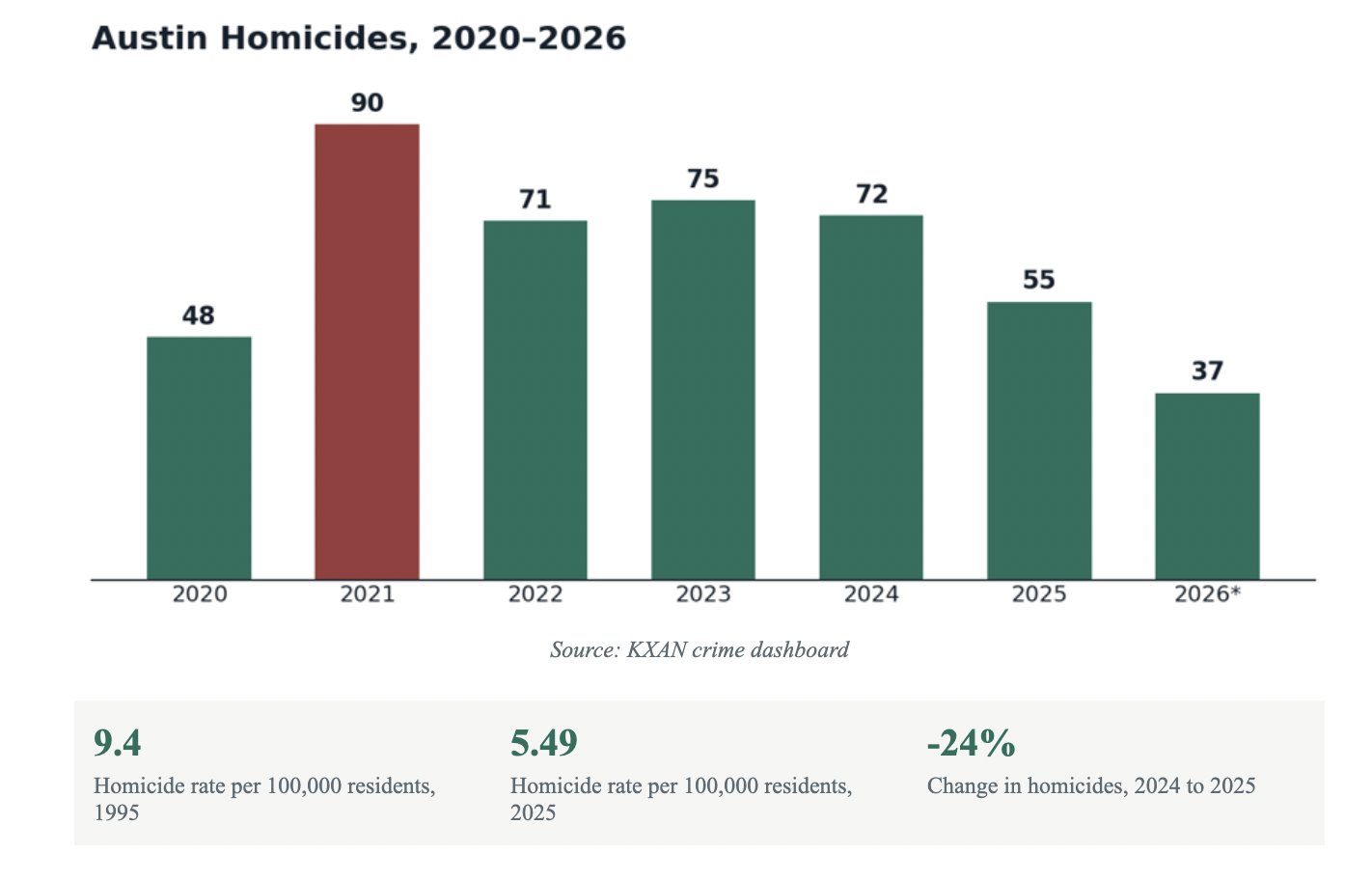
55 homicides is still too many, and every one represents a real loss. But context matters — Austin's current homicide rate remains far below where it stood two decades ago, even as the city's population has grown substantially.
02. Austin has fewer homicides than similarly sized cities
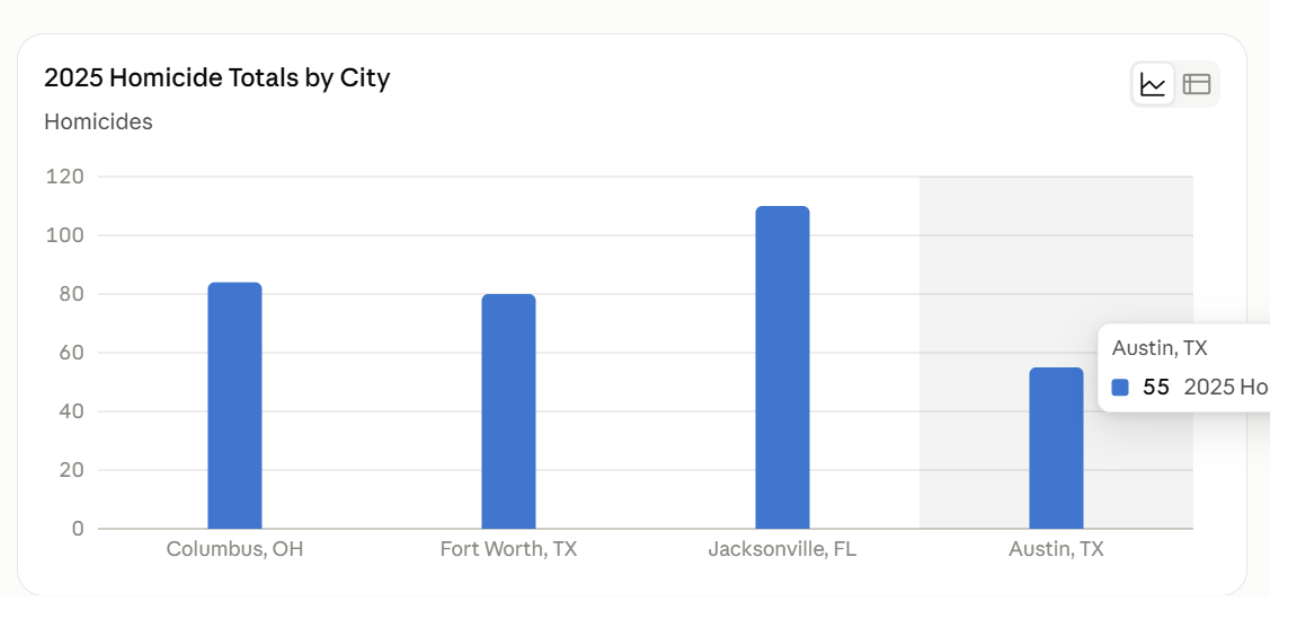
Comparing Austin to similarly sized cities is useful for understanding whether we are in crisis. We are not. As you can see below, Austin has had fewer homicides than most cities its size. In 2025, Austin, with a population of roughly 1 million, recorded 55 homicides. Fort Worth, with a nearly identical population, had 80. Jacksonville, similarly sized, had 1110. Columbus, Ohio — slightly smaller — had 84.
03. Overall, crime is down
The homicide trend isn't an outlier — it mirrors what's happening across nearly every crime category. During the last full year of data (2025 totals), Austin had about 90,064 crimes reported. In 2019, it had 103,047. And back in 2010, when Austin's population was far smaller, the city logged 136,593 incidents — meaning total crime has fallen even as the city has grown.
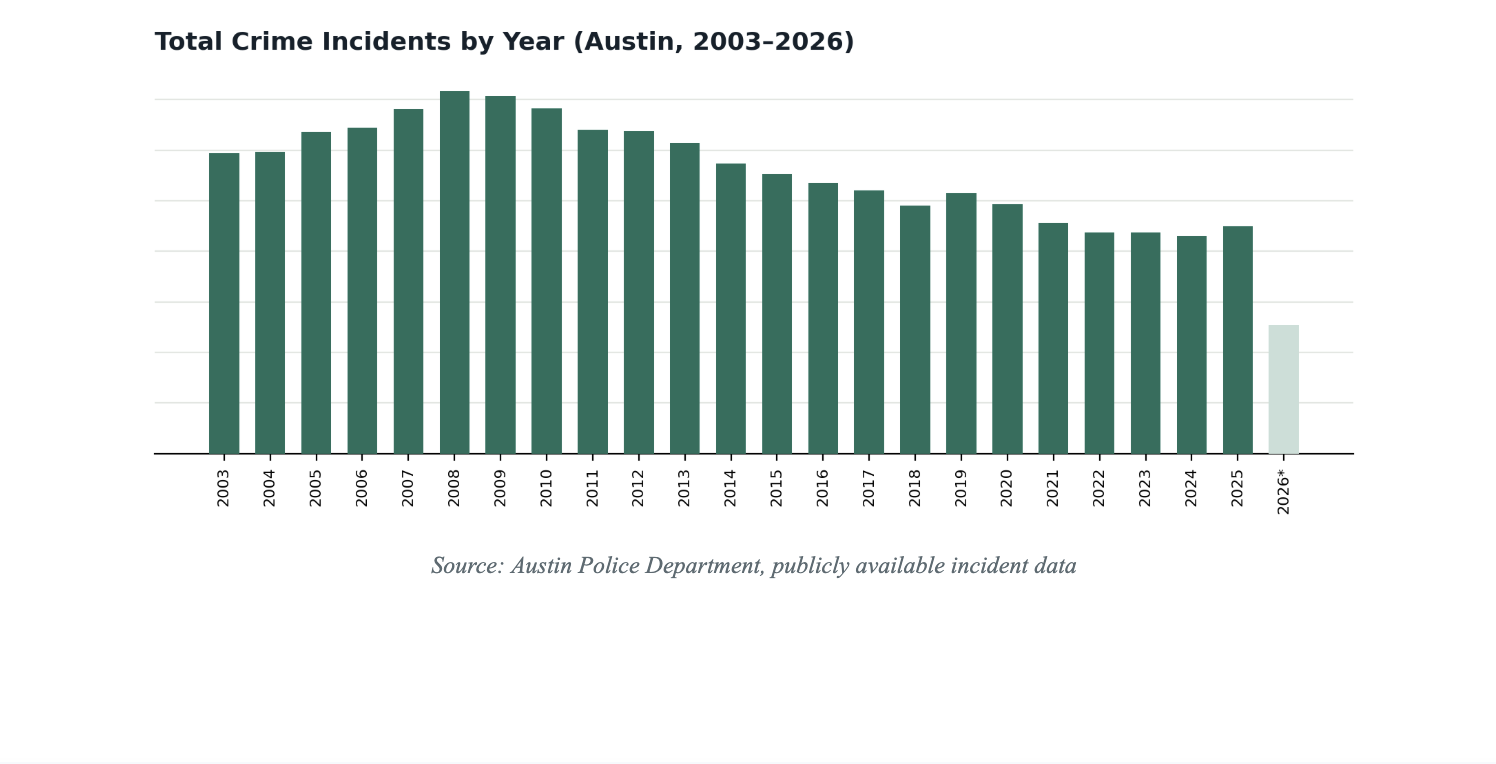
Looking specifically at the years DA José Garza has been in office, data published by the Council on Criminal Justice shows meaningful declines across several major categories:

04. The COVID spike wasn't a local policy failure — it was a nationwide pattern
People opposed to DA Garza have worked hard to pin the 2020–2021 spike on him, despite the fact that he did not even take office until 2021 and despite the numerous studies explaining why crime rose– everywhere during COVID. The research is clear on why crime spiked then: people were confined at home with nowhere to go, gun sales surged (especially in Texas), and tensions with people they had existing conflicts with had nowhere to dissipate. Suicide rates climbed during the same period — a related sign of how much people were struggling.
There has also been significant research conducted examining whether progressive prosecutors' policies move crime rates. They have reached a consistent conclusion: their policies don't move crime rates in either direction.
That conclusion holds up empirically, but it's also intuitive. When someone commits a serious violent act, they aren't weighing whether a prosecutor might hand down a 25-year sentence instead of a 50-year one. Both are severe. That calculation simply isn't part of how violent crime happens.
05. The ‘70% increase’ claim, explained
On social media, posts claim that homicides have risen 70% under Garza since 2019. That statistic cherry-picks one of the safest years on record in Austin as its baseline, and is two years before Garza takes office. Measured instead from 2020 — the year before Garza took office — homicides have risen just under 15% by 2025.

Here's what the ‘70%’ claim looks like translated into actual rates: in 2019, one of the safest years in Austin's recent history, the homicide rate was 3.8 per 100,000 residents. In 2025, it's 5.49. That's real, and it's worth taking seriously, but it's a very different picture from the one implied by a cherry-picked percentage.
Claims that Garza is ‘letting murderers go free’ are also false. No District Attorney in the country declines to prosecute murder when the evidence supports it.
06. What's actually making Austin safer
Austin has reduced crime by investing in programs that address its root causes. The city has put resources into violence intervention work and organizations supporting survivors and families of gun violence victims, including:
Life Works
Life Anew Restorative Justice
Jail to Jobs
The Safe Alliance
Lock Arms for Life
ATX Peace
African American Youth Harvest
These are the programs that save lives. They aren’t mentioned as much because they don't generate revenue for surveillance contractors and they don't help anyone stay in office by stoking fear. And that is one of the many reasons they are worth fighting for.
Data sources: Austin Police Department, KXAN crime dashboard, Council on Criminal Justice.